Aldo Gordillo, Polytechnic University of Madrid (Espanha)
Sonsoles López-Pernas, Polytechnic University of Madrid (Espanha)
Palavras chave
Competência digital, alfabetização digital, cursos online, MOOC, aprendizagem online, formação de professores, proteção online, conteúdo digital
Resumo
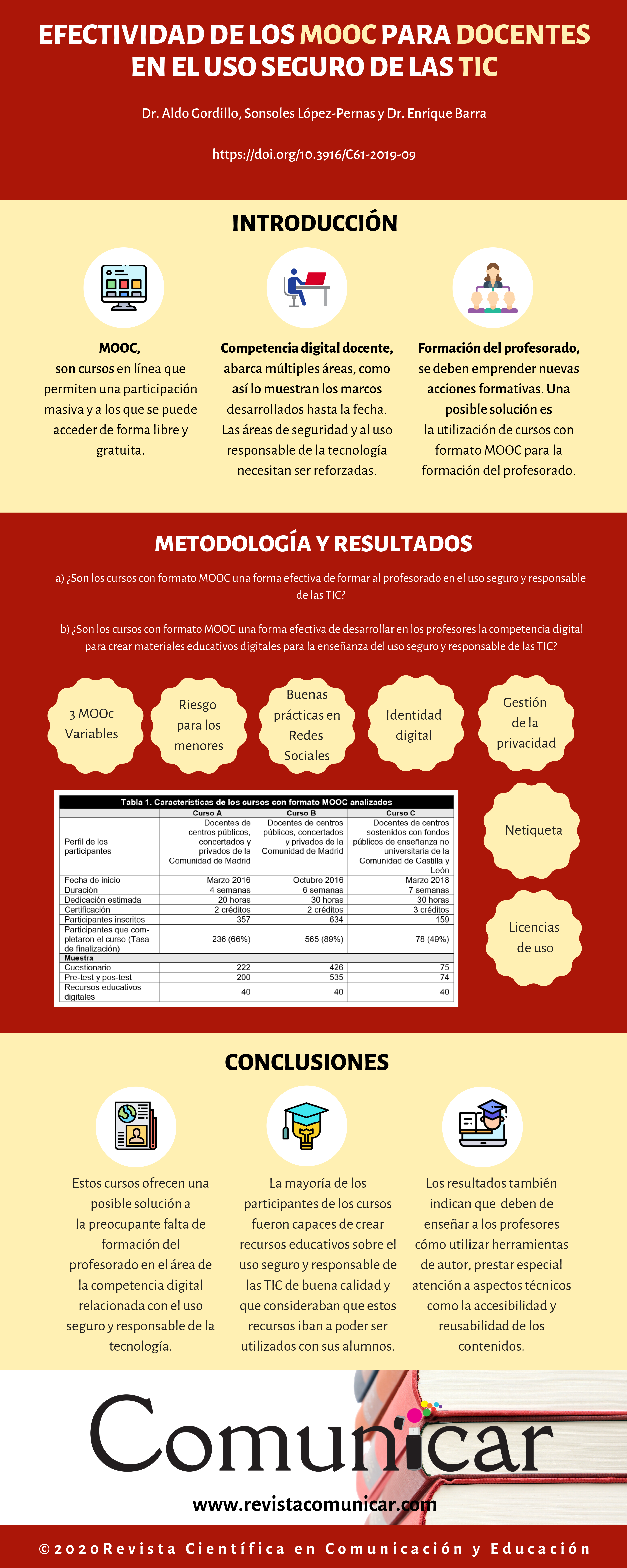
Apesar dos esforços realizados, ainda existe uma diferença alarmante entre a competência digital que os professores possuem e a que deveriam possuir para desenvolver a competência digital de seus alunos. A falta de formação de professores no uso seguro e responsável das TICs é uma questão que requer atenção especial. Os cursos online no formato MOOC preenchem todas as condições necessárias para oferecer uma possível solução para a necessidade inevitável e urgente de formação inicial e contínua de professores nessa área de competência digital. No entanto, atualmente não há evidências na literatura sobre a eficácia desses cursos para esse fim. Este estudo examina a efetividade instrucional dos cursos em formato MOOC para a formação de professores no uso seguro e responsável das TICs, mediante a analise de três cursos oficiais. Estes foram analisados por meio de três instrumentos diferentes: um questionário para medir a percepção dos participantes, pré-testes e pós-testes para medir os conhecimentos adquiridos e o instrumento de avaliação LORI (Learning Object Review Instrument) para mensurar a qualidade dos recursos educativos digitais criados pelos participantes. Os resultados sugerem que os cursos online no formato MOOC são uma forma efetiva de treinar professores no uso seguro e responsável das TICs, e que esses cursos podem ajudar no desenvolvimento da competência digital na área de criação de conteúdo.
Referências
Almerich, G., Suárez, J., Jornet, J., & Orellana, M. (2011). Las competencias y el uso de las tecnologías de información y comunicación (TIC) por el profesorado: estructura dimensional. Revista Electrónica de Investigación Educativa, 13(1), 28-42. http://bit.ly/2XOU7by
Better Internet for Kids (Ed.) (2018). #SaferInternet4EU campaign and Safer Internet Day 2018: Public report on campaign activities and successes. https://bit.ly/2TmG5PL
Link DOI | Link Google Scholar
Link DOI | Link Google Scholar
Link DOI | Link Google Scholar
Link DOI | Link Google Scholar
Comisión Europea (Ed.) (2010). Comunicación de la Comisión al Parlamento Europeo, al Consejo, al Comité Económico y Social Europeo y al Comité de las Regiones: Una agenda digital para Europa. https://bit.ly/2VLzmk3
Comisión Europea (Ed.) (2018). Comunicación de la Comisión al Parlamento Europeo, al Consejo, al Comité Económico y Social Europeo y al Comité de las Regiones sobre el plan de acción de educación digital. https://bit.ly/2YCsVwN
Link DOI | Link Google Scholar
De-los-Arcos, B., Cirigottis, G. E., Egglestone, N., Farrow, R., McAndrew, P., Perryman, L.A.,…Weller, M. (2015). OER data report 2013-2015: Building understanding of open education. https://bit.ly/2U97WzM
Link DOI | Link Google Scholar
Diario Oficial de la Unión Europea (Ed.) (2006). Recomendación del Parlamento Europeo y del Consejo de 18 de diciembre de 2006 sobre las competencias clave para el aprendizaje permanente (2006/962/CE). https://bit.ly/2JTJLDr
Link DOI | Link Google Scholar
Link DOI | Link Google Scholar
Link DOI | Link Google Scholar
Link DOI | Link Google Scholar
Link DOI | Link Google Scholar
Garmendia, M., Jiménez, E., Casado, M.A., & Marcheroni, G. (2016). Net Children go mobile: Riesgos y oportunidades en Internet y uso de dispositivos móviles entre menores españoles (2010-2015). https://bit.ly/2EeNiaI
Gómez-Trigueros, I. M. (2017). El MOOC como recurso para la adquisición de la competencia digital en la formación de los maestros de educación primaria. Revista de Tecnología de Información y Comunicación en Educación, 11(1), 77-88. http://bit.ly/2ZpELuC
Link DOI | Link Google Scholar
Link DOI | Link Google Scholar
Link DOI | Link Google Scholar
Link DOI | Link Google Scholar
INTEF (Ed.) (2017a). Cinco años de evolución de la competencia digital docente. https://bit.ly/2Eeyp8e
INTEF (Ed.) (2017b). Marco Común de Competencia Digital Docente. https://bit.ly/2BSzanb
Link DOI | Link Google Scholar
Link DOI | Link Google Scholar
Leacock, T.L., & Nesbit, J.C. (2007). A framework for evaluating the quality of multimedia learning resources. Educational Technology & Society, 10(2), 44-59. http://bit.ly/2F9IXqM
Link DOI | Link Google Scholar
Link DOI | Link Google Scholar
Ministerio de Educación, Cultura y Deporte. (2015). Orden ECD/65/2015. http://bit.ly/2XOVyGY
Link DOI | Link Google Scholar
Link DOI | Link Google Scholar
Link DOI | Link Google Scholar
Link DOI | Link Google Scholar
Link DOI | Link Google Scholar
Link DOI | Link Google Scholar
Røkenes, F.M., & Krumsvik, R.J. (2014). Development of student teachers’ digital competence in teacher education - A literature review. Nordic Journal of Digital Literacy, 9(4), 250-280. http://bit.ly/2Rgk5SZ
Sánchez-Elvira, A., & Santamaría-Lancho, M. (2013). Developing teachers and students’ digital competences by MOOCs: The UNED proposal. Proceedings of the 2013 Open and Flexible Higher Education Conference (pp. 362-376). http://bit.ly/2XmEDyQ
Link DOI | Link Google Scholar
Link DOI | Link Google Scholar
Siemens, G. (2013). Massive open online courses: Innovation in education? In R. McGreal, W. Kinuthia, & S. Marshall (Eds.), Open Educational Resources: Innovation, research and practice (pp. 5-16). Commonwealth of Learning, Athabasca University. http://bit.ly/2RhB5bs
Link DOI | Link Google Scholar
Link DOI | Link Google Scholar
UNESCO (Ed.) (2011). UNESCO ICT competency framework for teachers. https://bit.ly/2V9TuYC
Link DOI | Link Google Scholar
Crossmark

Technical information
Recebido: 26-02-2019
Revisado: 28-04-2019
Aceite: 10-05-2019
OnlineFirst: 15-07-2019
Data de publicação: 01-10-2019
Tempo de revisão do artigo: 61 dias | Tempo médio de revisão do número 61: 43 dias
Tempo de aceitação do artigo: 73 dias | Tempo médio de aceitação do número 61: 79 dias
Tempo de edição da pré-impressão: 172 dias | Tempo médio de edição pré-impressão do número 61: 178 dias
Tempo de processamento do artigo: 217 dias | Tempo médio de processamento do número 61: 223 dias
Métricas
Métricas deste artigo
Vistas: 56539
Leituras dos resumos: 48795
Descargas em PDF: 7744
Métricas completas do Comunicar 61
Vistas: 749739
Leituras dos resumos: 655099
Descargas em PDF: 94640
Citado por

Citas em Web of Science
Guillen-Gamez, Francisco D.; Ruiz-Palmero, Julio; Sanchez-Rivas, Enrique; Colomo-Magana, Ernesto; . ICT resources for research: an ANOVA analysis on the digital research skills of higher education teachers comparing the areas of knowledge within each gender European Journal of Research and Reflection in Educational Sciences, 2020.
https://doi.org/10.1007/s10639-020-10176-6
Ortega-Sanchez, Delfin; Gomez-Trigueros, Isabel Maria; . MOOCs and NOOCs in the Training of Future Geography and History Teachers: A Comparative Cross-Sectional Study Based on the TPACK Model DATA IN BRIEF, 2020.
https://doi.org/10.1109/ACCESS.2019.2963314
Romero-Rodriguez, Luis M.; Soledad Ramirez-Montoya, Maria; Aguaded, Ignacio; . Determining Factors in MOOCs Completion Rates: Application Test in Energy Sustainability Courses PROCEEDINGS OF 2019 IEEE LEARNING WITH MOOCS (IEEE LWMOOCS VI 2019), 2020.
https://doi.org/10.3390/su12072893
Marin, Victoria I.; Carpenter, Jeffrey P.; Tur, Gemma; . Pre-service teachers' perceptions of social media data privacy policies COMUNICAR, 2021.
https://doi.org/10.1111/bjet.13035
Coppari, Norma B.; Gonzalez, Hugo; Bagnoli, Laura; Maidana, Paula; Ortiz, Ariel; Recalde, Jestis; . The day after: Impact of COVID-19 on teachers and their educational labor in Paraguay AMERICAN PSYCHOLOGIST, 2021.
https://doi.org/10.7714/CNPS/15.3.202
Toscano-Alonso, Maria; Aguaded Gomez, Ignacio; Manotas Salcedo, Edna M.; Farias-Gaytan, Silvia C.; . Audiovisual Production in University: Spaces for Teaching Innovation in Iberoamerica Enfoques, 2022.
https://doi.org/10.5944/ried.25.1.30611
Okoye, Kingsley; Arrona-Palacios, Arturo; Camacho-Zuniga, Claudia; Hammout, Nisrine; Nakamura, Emilia Luttmann; Escamilla, Jose; Hosseini, Samira; . Impact of students evaluation of teaching: a text analysis of the teachers qualities by gender INTERNATIONAL JOURNAL OF EDUCATIONAL TECHNOLOGY IN HIGHER EDUCATION, 2020.
https://doi.org/10.1186/s41239-020-00224-z
Boumadan, Moussa; Soto-Varela, Roberto; Ortiz-Padilla, Myriam; Poyatos-Dorado, Cesar; . What Factors Determine the Value of an Online Teacher Education Experience from a Teacher's Perspective? COMPUTERS & EDUCATION, 2020.
https://doi.org/10.3390/su12198064
Gomez-Galan, Jose; Lizaro-Perez, Cristina; Angel Martinez-Lopez, Jose; Lopez-Meneses, Eloy; . Measurement of the MOOC Phenomenon by Pre-Service Teachers: A Descriptive Case Study High. Educ. Stud., 2020.
https://doi.org/10.3390/educsci10090215
Estrada-Molina, O and Fuentes-Cancell, DR. Engagement and desertion in MOOCs: Systematic review COMUNICAR, 2022.
https://doi.org/10.3916/C70-2022-09
Gordillo, Aldo; Barra, Enrique; Lopez-Pernas, Sonsoles; Quemada, Juan; . Development of Teacher Digital Competence in the Area of E-Safety through Educational Video Games INFORMATION SCIENCES, 2021.
https://doi.org/10.3390/su13158485
Gordillo, A; Barra, E; (...); Lopez-Pernas, S. Use of a Simulated Social Network as an Educational Tool to Enhance Teacher Digital Competence IEEE REVISTA IBEROAMERICANA DE TECNOLOGIAS DEL APRENDIZAJE-IEEE RITA, 2021.
https://doi.org/10.1109/RITA.2021.3052686
Okoye, Kingsley; Arrona-Palacios, Arturo; Camacho-Zuniga, Claudia; Achem, Joaquin Alejandro Guerra; Escamilla, Jose; Hosseini, Samira; . Towards teaching analytics: a contextual model for analysis of students' evaluation of teaching through text mining and machine learning classification BIG DATA, 2000.
https://doi.org/10.1007/s10639-021-10751-5
Cabero-Almenara, J; Barroso-suna, J; (...); Llorente-Cejudo, C. Evaluation of university t-MOOC on teaching digital competences through expert judgment according to the DigCompEdu Framework RED-REVISTA DE EDUCACION A DISTANCIA, 2021.
https://doi.org/10.6018/red.476891
Rajas-Fernandez, Mario; Gertrudix-Barrio, Manuel; Banos-Gonzalez, Miguel; . Knowledge in Images and Sounds: Informative, Narrative and Aesthetic Analysis of the Video for MOOC RIED-REVISTA IBEROAMERICANA DE EDUCACION A DISTANCIA, 2021.
https://doi.org/10.3390/publications9030032
Cabero-Almenara, J; Barragan-Sanchez, R; (...); Martin-Parraga, L. Design and Validation of t-MOOC for the Development of the Digital Competence of Non-University Teachers TECHNOLOGIES, 2021.
https://doi.org/10.3390/technologies9040084
Okoye, K; Hussein, H; (...); Hosseini, S. Impact of digital technologies upon teaching and learning in higher education in Latin America: an outlook on the reach, barriers, and bottlenecks EDUCATION AND INFORMATION TECHNOLOGIES, 2022.
https://doi.org/10.1007/s10639-022-11214-1
Basantes-Andrade, A; Cabezas-Gonzalez, M; (...); Benavides-Piedra, A. NANO-MOOCs to train university professors in digital competences Heliyon, 2022.
https://doi.org/10.1016/j.heliyon.2022.e09456
Amado, C; Dorotea, N; (...); Piedade, J. MOOCs Design: A Conceptual Framework for Continuous Teacher Training in Portugal EDUCATION SCIENCES, 2022.

Citas em Scopus
Ortega-Sanchez, D., Gomez-Trigueros, I.M. . MOOCs and NOOCs in the Training of Future Geography and History Teachers: A Comparative Cross-Sectional Study Based on the TPACK Model), IEEE Access, .
https://doi.org/10.1109/ACCESS.2019.2963314
Guillén-Gámez, F.D., Ruiz-Palmero, J., Sánchez-Rivas, E., Colomo-Magaña, E. . ICT resources for research: an ANOVA analysis on the digital research skills of higher education teachers comparing the areas of knowledge within each gender), Education and Information Technologies, .
https://doi.org/10.1007/s10639-020-10176-6
Romero-Rodríguez, L.M., Ramírez-Montoya, M.S., Aguaded, I. . Determining factors in MOOCs completion rates: Application test in energy sustainability courses), Sustainability (Switzerland), .
https://doi.org/10.3390/su12072893
Marín, V.I., Carpenter, J.P., Tur, G. . Pre-service teachers’ perceptions of social media data privacy policies), British Journal of Educational Technology, .
https://doi.org/10.1111/bjet.13035
Okoye, K., Arrona-Palacios, A., Camacho-Zuñiga, C., (...), Escamilla, J., Hosseini, S. . Impact of students evaluation of teaching: a text analysis of the teachers qualities by gender), International Journal of Educational Technology in Higher Education, .
https://doi.org/10.1186/s41239-020-00224-z
Boumadan, M., Soto-Varela, R., Poyatos-Dorado, C., Ortiz-Padilla, M. . What factors determine the value of an online teacher education experience from a teacher’s perspective?), Sustainability (Switzerland), .
https://doi.org/10.3390/su12198064
Gómez-Galán, J., Lázaro-Pérez, C., Martínez-López, J.Á., López-Meneses, E. . Measurement of the MOOC phenomenon by pre-service teachers: A descriptive case study), Education Sciences, .
https://doi.org/10.3390/educsci10090215
Bonilla-Del-Río, M., Castillo-Abdul, B., Civila, S. . Impact of the MOOCx's conventional educational design), Sustainability (Switzerland), .
https://doi.org/10.1145/3434780.3436654
Gordillo, A., Barra, E., Garaizar, P., Lopez-Pernas, S. . Use of a Simulated Social Network as an Educational Tool to Enhance Teacher Digital Competence), Revista Iberoamericana de Tecnologias del Aprendizaje, .
https://doi.org/10.1109/RITA.2021.3052686
Zhang, X. . Mobile-Assisted Writing Instruction: Affordances, Challenges, and Future Directions), International Journal of Interactive Mobile Technologies, .
https://doi.org/10.3991/ijim.v15i10.21519
Rajas-Fernández, M., Gértrudix-Barrio, M., Baños-González, M. . Knowledge in images and sounds: Informative, narrative and aesthetic analysis of the video for MOOC), Publications, .
https://doi.org/10.3390/publications9030032
Gordillo, A., Barra, E., López-Pernas, S., Quemada, J. . Development of teacher digital competence in the area of e-safety through educational video games), Sustainability (Switzerland), .
https://doi.org/10.3390/su13158485
Toscano-Alonso, M., Aguaded Gómez, I., Manotas Salcedo, E.M., Farias-Gaytán, S.C. . Audiovisual production in university: Spaces for teaching innovation in iberoamerica | [Producción audiovisual universitaria: Espacios de innovación docente en iberoamérica]), #EANF#, .
https://doi.org/10.5944/ried.25.1.30611
Estrada-Molina, O., Fuentes-Cancell, D.-R. . Engagement and desertion in MOOCs: Systematic review | [El engagement y la deserción en los MOOCs: Revisión sistemática]), Revista de Educacion a Distancia, .
https://doi.org/10.3916/C70-2022-09
Cabero-Almenara, J., Barroso-Osuna, J., Palacios-Rodríguez, A., Llorente-Cejudo, C. . Evaluation of university t-MOOC on teaching digital competences through expert judgment according to the DigCompEdu Framework | [Evaluación de t-MOOC universitario sobre competencias digitales docentes mediante juicio de expertos según el Marco DigCompEdu]), Publications, .
https://doi.org/10.6018/RED.476891
Butkiene, R., Gudoniene, D., Staneviciene, E. . An Engineering Solution for a Correlation Between a Competences Framework and Learning Units in an Educational Platform), Education and Information Technologies, .
https://doi.org/10.1007/978-3-030-88304-1_22
Okoye, K., Arrona-Palacios, A., Camacho-Zuñiga, C., (...), Escamilla, J., Hosseini, S. . Towards teaching analytics: a contextual model for analysis of students’ evaluation of teaching through text mining and machine learning classification), Education and Information Technologies, .
https://doi.org/10.1007/s10639-021-10751-5
Amado, C., Dorotea, N., Pedro, A., Piedade, J.. MOOCs Design: A Conceptual Framework for Continuous Teacher Training in Portugal), Education Sciences, .
https://doi.org/10.3390/educsci12050308
Tzovla, E., Kedraka, K., Karalis, T., Kougiourouki, M., Lavidas, K.. Effectiveness of In-Service Elementary School Teacher Professional Development MOOC: An Experimental Research), Contemporary Educational Technology, .
https://doi.org/10.30935/cedtech/11144
Okoye, K., Hussein, H., Arrona-Palacios, A., (...), Escamilla, J., Hosseini, S. . Impact of digital technologies upon teaching and learning in higher education in Latin America: an outlook on the reach, barriers, and bottlenecks), Education and Information Technologies, .

Citas em Google Scholar
Romero-Rodríguez, L. M., Ramírez-Montoya, M. S., & Aguaded, I. (2020). Determining factors in MOOCs completion rates: Application test in energy sustainability courses. Sustainability, 12(7), 2893.
Ramírez-Montoya, M. S., Romero-Rodríguez, L. M., & Aguaded, I. Determining Factors in MOOCs Completion Rates: Application Test in Energy Sustainability Courses.
https://repositorio.tec.mx/handle/11285/636325
Ortega-Sánchez, D., & Gómez-Trigueros, I. M. (2019). MOOCs and NOOCs in the training of future geography and history teachers: A comparative cross-sectional study based on the TPACK model. IEEE Access, 8, 4035-4042.
https://ieeexplore.ieee.org/abstract/document/8946624/
Murillo, E. B. (2020). MOOC y Educación Basada en Competencias: Alternativas para la Educación del siglo XXI. Revista DIM: Didáctica, Innovación y Multimedia, (38), 10.
https://ddd.uab.cat/pub/dim/dim_a2020n38/dim_a2020n38a10.pdf
Galán, J. G. LOS CURSOS MOOC COMO RECURSO EN LOS PROCESOS INTERNACIONALES DE COOPERACIÓN AL DESARROLLO EDUCATIVO.
https://www.eumed.net/actas/20/desarrollo-empresarial/20-los-cursos-mooc-como-recurso.pdf
Murillo, E. B. (2020). MOOC y educación basada en competencias. DIM: Didáctica, Innovación y Multimedia, (38).
https://www.raco.cat/index.php/DIM/article/view/371583
Gómez-Galán, J., Lázaro-Pérez, C., Martínez-López, J. Á., & López-Meneses, E. (2020). Measurement of the MOOC phenomenon by pre-service teachers: A descriptive case study. Education Sciences, 10(9), 215.
Gordillo, A. G., López-Pernas, S. L. P., Barra, E. B., Gordillo, A., López-Pernas, S., & Barra, E. (2019). Effectiveness of MOOCs for teachers in safe ICT use training. Comunicar. Media Education Research Journal, 27(2).
https://www.scipedia.com/public/Gordillo_et_al_2019a
Guillén-Gámez, F. D., Ruiz-Palmero, J., Sánchez-Rivas, E., & Colomo-Magaña, E. (2020). ICT resources for research: An ANOVA analysis on the digital research skills of higher education teachers comparing the areas of knowledge within each gender. Education and information technologies, 25(5), 4575-4589.
https://link.springer.com/article/10.1007/s10639-020-10176-6
Boumadan, M., Soto-Varela, R., Ortiz-Padilla, M., & Poyatos-Dorado, C. (2020). What factors determine the value of an online teacher education experience from a teacher’s perspective?. Sustainability, 12(19), 8064.
Marín, V. I., Carpenter, J. P., & Tur, G. (2020). Pre‐service teachers’ perceptions of social media data privacy policies. British Journal of Educational Technology, e13035.
https://bera-journals.onlinelibrary.wiley.com/doi/abs/10.1111/bjet.13035
Haro Olmo, F. J. D., Varela-Vaca, Á. J., & Álvarez Bermejo, J. A. (2021). 66 Curso de Especialización en Ciberseguridad,¿ están preparados nuestros docentes?.
https://ruidera.uclm.es/xmlui/handle/10578/28676
Okoye, K., Arrona-Palacios, A., Camacho-Zuñiga, C., Hammout, N., Nakamura, E. L., Escamilla, J., & Hosseini, S. (2020). Impact of students evaluation of teaching: a text analysis of the teachers qualities by gender. International Journal of Educational Technology in Higher Education, 17(1), 1-27.
https://educationaltechnologyjournal.springeropen.com/articles/10.1186/s41239-020-00224-z
Diez-Martinez, E., & Morales-Velasco, R. A. (2020). Codiseño de Objetos de Aprendizaje OA como estrategia de capacitación a docentes de Educación Superior. Edutec. Revista Electrónica De Tecnología Educativa, (74), 114-126.
https://www.edutec.es/revista/index.php/edutec-e/article/view/1765
Bonilla-del-Río, M., Castillo-Abdul, B., & Civila, S. (2020, October). Impact of the MOOCx's conventional educational design. In Eighth International Conference on Technological Ecosystems for Enhancing Multiculturality (pp. 593-599).
https://dl.acm.org/doi/abs/10.1145/3434780.3436654
Gordillo, A., Barra, E., Garaizar, P., & López-Pernas, S. (2021). Use of a Simulated Social Network as an Educational Tool to Enhance Teacher Digital Competence. IEEE Revista Iberoamericana de Tecnologias del Aprendizaje, 16(1), 107-114.
https://ieeexplore.ieee.org/abstract/document/9328278/
Gordillo, A., Barra, E., López-Pernas, S., & Quemada, J. (2021). Development of Teacher Digital Competence in the Area of E-Safety through Educational Video Games. Sustainability 2021, 13, 8485.
Gordillo, A., Barra, E., López-Pernas, S., & Quemada, J. (2021). Development of Teacher Digital Competence in the Area of E-Safety through Educational Video Games. Sustainability, 13(15), 8485.
https://www.mdpi.com/2071-1050/13/15/8485
Chávez Armas, E. A. (2021). Gestión de competencias digitales en el marco del buen desempeño docente de instituciones educativas de la Ugel Ascope, 2021.
https://repositorio.ucv.edu.pe/handle/20.500.12692/66575
Canchola González, J. A. Alfabetización digital: factor determinante en participantes adultos para concluir x MOOC sobre sustentabilidad energética.
https://repositorio.tec.mx/handle/11285/637224
Tzovla, E., Kedraka, K., Karalis, T., Kougiourouki, M., & Lavidas, K. (2021). Effectiveness of In-Service Elementary School Teacher Professional Development MOOC: An Experimental Research. Contemporary Educational Technology, 13(4), ep324.
Rajas-Fernández, M., Gértrudix-Barrio, M., & Baños-González, M. (2021). Knowledge in Images and Sounds: Informative, Narrative and Aesthetic Analysis of the Video for MOOC. Publications, 9(3), 32.
Zhang, X. (2021). Mobile-Assisted Writing Instruction: Affordances, Challenges, and Future Directions. International Journal of Interactive Mobile Technologies, 15(10).
Baixar



Métricas alternativas
Como citar
Gordillo, A., López-Pernas, S., & Barra, E. (2019). Effectiveness of MOOCs for teachers in safe ICT use training. [Efectividad de los MOOC para docentes en el uso seguro de las TIC]. Comunicar, 61, 103-112. https://doi.org/10.3916/C61-2019-09
Compartilhar








Oxbridge Publishing House
4 White House Way
B91 1SE Sollihul United Kingdom
Administração 
Redação