Keywords
Critical citizenship, critical thinking, media education, social mobilization, educational software, technology innovation, collective intelligence, textual analysis
Abstract
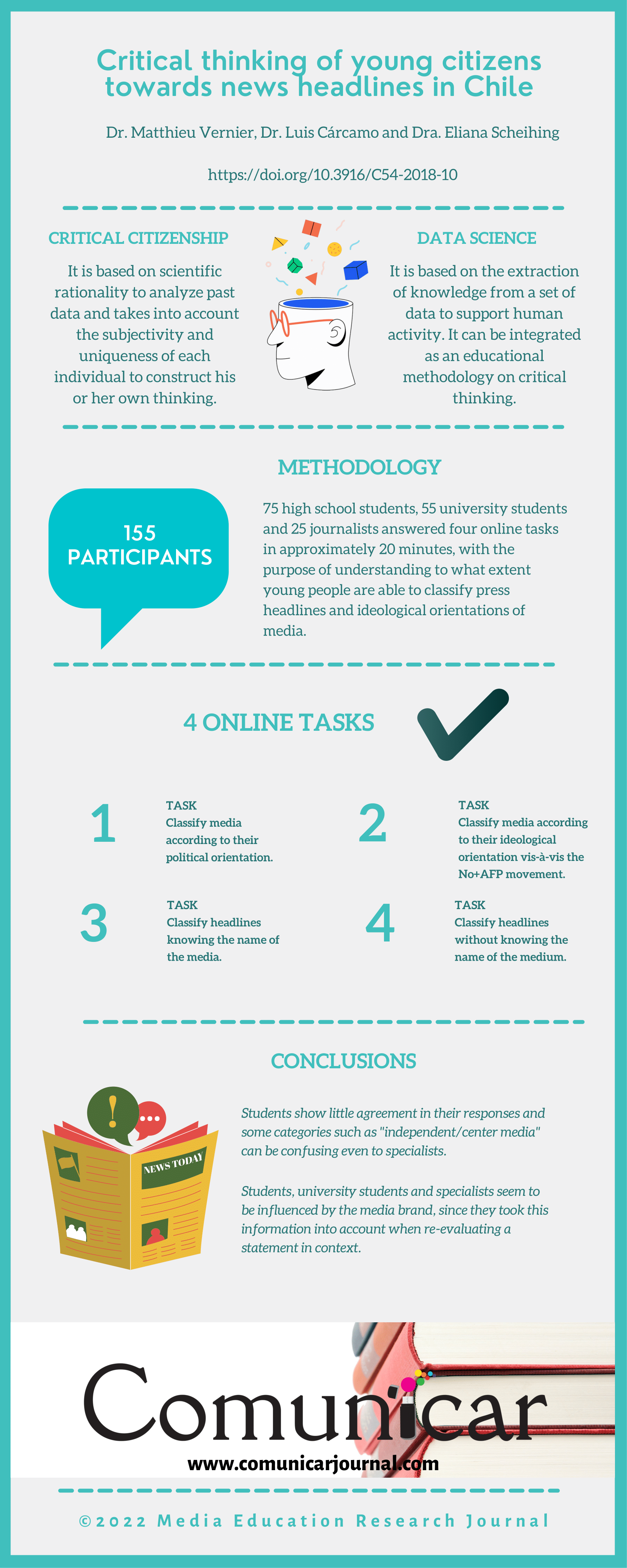
Strengthening critical thinking abilities of citizens in the face of news published on the web represents a key challenge for education. Young citizens appear to be vulnerable in the face of poor quality news or those containing nonexplicit ideologies. In the field of data science, computational and statistical techniques have been developed to automatically collect and characterize online news media in real time. Nevertheless, there is still not a lot of interdisciplinary research on how to design data exploration platforms supporting an educational process of critical citizenship. This article explores this opportunity through a case study analyzing critical thinking ability of students when facing news dealing with the social mobilization “No+APF”. From data collected through 4 online exercises conducted by 75 secondary school students, 55 university students and 25 communication specialists, we investigate to what extent young citizens are able to classify news headlines and ideological orientation of news media outlets. We also question the influence of the media’s brand name and the subjectivity of each participant in regards to the social mobilization “No+APF”. The results underline the importance of group work, the influence of the brand name and the correlation between criticalthinking abilities and having a defined opinion.
References
Link DOI | Link Google Scholar
Link DOI | Link Google Scholar
Link DOI | Link Google Scholar
Link DOI | Link Google Scholar
Barranquero-Carretero, A., Lema-Blanco, I. (2016). La juventud española y los medios del Tercer Sector de la Comunicación. Madrid: Centro Reina Sofía sobre Adolescencia y Juventud /FAD. (goo.gl/EGRfJ3).
Cadem (2016). Track semanal de opinión pública, 16 de Agosto 2016, Estudio #135. (http://goo.gl/QJJ6dQ).
Link DOI | Link Google Scholar
Link DOI | Link Google Scholar
Link DOI | Link Google Scholar
Link DOI | Link Google Scholar
Link DOI | Link Google Scholar
Link DOI | Link Google Scholar
Link DOI | Link Google Scholar
Link DOI | Link Google Scholar
Freinet, C. (1927). L’imprimerie à l’école. Brochures d’éducation nouvelle populaire. Boulogne, Ferrary.
Link DOI | Link Google Scholar
Iglesias, M. (2011). Rompiendo el cerco: el movimiento de pobladores contra la dictadura. Santiago: Radio Universidad de Chile.
Islas, O. (2010). Internet 2.0: El territorio digital de los prosumidores. Estudios Culturales, 5(3), 43-64. (http://goo.gl/RJJk6b).
Link DOI | Link Google Scholar
Link DOI | Link Google Scholar
Link DOI | Link Google Scholar
Link DOI | Link Google Scholar
Link DOI | Link Google Scholar
Maigrot, C., Kijak, E., & Claveau, V. (2016). Médias traditionnels, médias sociaux: Caractériser la réinformation. TALN 2016 - 23ème Conférence sur le Traitement Automatique des Langues Naturelles, Jul. 2016, Paris, France. (http://goo.gl/2Lrzze).
Link DOI | Link Google Scholar
Paul, R., & Elder, L. (2005). Estándares de competencia para el pensamiento crítico. Estándares, principios, desempeño, indicadores y resultados con una rúbrica maestra en el pensamiento crítico. Dillon Beach: Fundación para el Pensamiento Crítico. (http://goo.gl/UMVRP1).
Link DOI | Link Google Scholar
Link DOI | Link Google Scholar
Ruiz, A., Medina, M., & García, L. (2001). ¿Fomenta la prensa onubense la integración de los inmigrantes en nuestra sociedad? Comunicar, 17, 176-179. (http://goo.gl/Lrg92C).
Scolari, C. (2015). Ecología de los medios: entornos, evoluciones e interpretaciones. Madrid. Gedisa.
Link DOI | Link Google Scholar
Surowiecki, J. (2004). The wisdom of crowds. New York: Anchor.
Vernier, M., Cárcamo-Ulloa, L., & Scheihing, E. (2016). Diagnóstico de la estrategia editorial de medios informativos chilenos en Twitter mediante un clasificador de noticias automatizado. Revista Austral de Ciencias Sociales, 30, 183-201. (goo.gl/D7msKH).
Link DOI | Link Google Scholar
Wolton, D. (2011). Informar no es comunicar. Madrid: Gedisa.
Crossmark

Technical information
Received: 28-02-2017
Revised: 03-04-2017
Accepted: 28-07-2017
OnlineFirst: 15-11-2017
Publication date: 01-01-2018
Article revision time: 34 days | Average time revision issue 54: 44 days
Article acceptance time: 150 days | Average time of acceptance issue 54: 97 days
Preprint editing time: 262 days | Average editing time preprint issue 54: 210 days
Article editing time: 307 days | Average editing time issue 54: 255 days
Metrics
Metrics of this article
Views: 54377
Abstract readings: 45453
PDF downloads: 8924
Full metrics of Comunicar 54
Views: 1719047
Abstract readings: 1118311
PDF downloads: 600736
Cited by

Cites in Web of Science
Mensa, M; Vernier, M; (...); Sotomayor-Gomez, B. Gender (in)equality in Chilean press: journalists and sources REVISTA DE COMUNICACION-PERU, 2021.
https://doi.org/10.26441/RC20.2-2021-A14
Sixto-Garcia, J; Soengas-Perez, X; (...); Lopez-Garcia, X. Social perception of journalism in Spain ADCOMUNICA-REVISTA CIENTIFICA DE ESTRATEGIAS TENDENCIAS E INNOVACION EN COMMUNICACION , 2021.
https://doi.org/10.6035/2174-0992.2021.22.11
Tommasi, Francesco; Ceschi, Andrea; Sartori, Riccardo; Gostimir, Marija; Passaia, Giulia; Genero, Silvia; Belotto, Silvia; . Enhancing critical thinking and media literacy in the context of IVET: a systematic scoping review EUROPEAN JOURNAL OF TRAINING AND DEVELOPMENT, 2000.
https://doi.org/10.1108/EJTD-06-2021-0074
Carcamo-Ulloa, Luis; Cardenas-Neira, Camila; Saez-Trumper, Diego; Toural-Bran, Carlos; . Fake news in Chile and Spain: How do the media tell us about fake news? JOURNAL OF IBERIAN AND LATIN AMERICAN RESEARCH, 2021.
https://doi.org/10.1080/13260219.2020.1909849
Gil-Quintana, Javier; Cano-Alfaro, Alejandro; . Digital inclusion: a challenge for school organisation. planning and teaching REVISTA MEDITERRANEA COMUNICACION-JOURNAL OF COMMUNICATION, 2020.
De-la-Garza-Montemayor, Daniel-Javier; Pena-Ramos, Jose-Antonio; Recuero-Lopez, Fatima; . Online political participation of young people in Mexico, Spain and Chile UTOPIA Y PRAXIS LATINOAMERICANA-REVISTA INTERNACIONAL DE FILOSOFIA IBEROAMERICANA Y TEORIA SOCIAL, 2019.
https://doi.org/10.3916/C61-2019-07
Saez, Virginia; . Characteristics of media literacy education at the secondary level: An Argentinian case study ACTUALIDADES PEDAGOGICAS, 2019.
https://doi.org/10.19052/ap.vol1.iss74.5
Soengas-Perez, X; Lopez-Cepeda, AM and Sixto-Garcia, J. Media diet, consumption habits and misinformation among Spanish university students REVISTA LATINA DE COMUNICACION SOCIAL, 2019.
https://doi.org/10.4185/RLCS-2019-1371-54
Giron-Gambero, JR and Lupion-Cobos, T. Influence of Advertising on Teenagers' Arguments about Food Consumption ENSENANZA DE LAS CIENCIAS, 2022.

Cites in Scopus
Aguilar, H.G.. The APA style in articles indexed in Scopus, Web of Science [El estilo APA en artículos indizados en Scopus y Web of Science]), Revista Electronica de Veterinaria, .
Undurraga, R., Becker, J.. Young women workers, pensions in Chile [Mujeres trabajadoras jóvenes y pensiones en Chile]), Psicoperspectivas, .
https://doi.org/10.5027/psicoperspectivas-vol18-issue3-fulltext-1658
De-la-Garza-Montemayor, D.-J., Peña-Ramos, J.-A., Recuero-López, F.. Online political participation of young people in Mexico, Spain, Chile), Comunicar, .
https://doi.org/10.3916/C61-2019-07
GIL-QUINTANA, J., CANO-ALFARO, A. . Digital inclusion: A challenge for school organisation, planning and teaching | [Inclusión digital: Un reto para la organización, planificación y didáctica escolar]), Revista Latina de Comunicacion Social, .
https://doi.org/10.14198/MEDCOM2020.11.1.6
Soengas-Pérez, X., López-Cepeda, A.M., Sixto-García, J. . Media diet, consumption habits and misinformation among Spanish university students), Comunicar, .
https://doi.org/10.4185/RLCS-2019-1371-54en
Tommasi, F., Ceschi, A., Sartori, R., (...), Genero, S., Belotto, S. . Enhancing critical thinking and media literacy in the context of IVET: a systematic scoping review), European Journal of Training and Development, .
https://doi.org/10.1108/EJTD-06-2021-0074
Mensa, M., Vernier, M., Cárcamo-Ulloa, L., Ruíz, F., Sotomayor-Gómez, B.. Gender (in)equality in Chilean press: Journalists and sources | [(In)Equidad de género en la prensa chilena: Periodistas y fuentes), Revista de Comunicacion, .
https://doi.org/10.26441/RC20.2-2021-A14
Girón-Gambero, J.R., Lupión-Cobos, T. . Influence of Advertising on Teenagers’ Arguments about Food Consumption ), Ensenanza de las Ciencias, .

Cites in Google Scholar
HACHLAF, O. (2018). Pre-service Teachers’ Perceptions of Critical Thinking of Science Instruction and Lesson Planning in UAE’s Schools (Doctoral dissertation, The British University in Dubai (BUiD)).
https://bspace.buid.ac.ae/handle/1234/1275
Camas, L., Valero, A., & Vendrell, M. (2018). Hackeando memes: cultura democrática, redes sociales y educación.
http://repositorio.ual.es/bitstream/handle/10835/6222/2017-6245-1-PB.pdf?sequence=1
González Aguilar, H. (2018). El estilo APA en artículos indizados en Scopus y Web of Science. Revista electrónica de Veterinaria, 19(10).
http://repositorio.usil.edu.pe/handle/USIL/3172
Garrido, L. C., Moya, A. V., & Morancho, M. V. (2018). “Hackeando memes”: Cultura democrática, redes sociales y educación|“Hacking memes”: Democratic culture, social media and education. Espiral. Cuadernos del profesorado, 11(23), 120-129.
http://ojs.ual.es/ojs/index.php/ESPIRAL/article/view/2017
Castro, M. D. P. Q., Arellano, M. D. P. C., Castillo, C. A. D., Aguila, C. I. G., Núñez, J. M. O., & Castro, G. A. Q. (2020). MÉTODO DE CASOS PARA PROMOVER EL PENSAMIENTO CRÍTICO DE ESTUDIANTES DE DERECHO EN ENTORNOS VIRTUALES DE APRENDIZAJE. Universidad Ciencia y Tecnología, 24(102), 4-10.
https://uctunexpo.autanabooks.com/index.php/uct/article/view/336
Gil-Quintana, J., & Cantillo Valero, C. (2019). Humanización del consumo vs. deshumanización del ser humano: estudio de caso de anuncios publicitarios en aulas de Educación Primaria. Humanización del consumo vs. deshumanización del ser humano: estudio de caso de anuncios publicitarios en aulas de Educación Primaria, 431-460.
https://www.torrossa.com/gs/resourceProxy?an=4685574&publisher=FZ1825
Pérez, X. S., Cepeda, A. M. L., & García, J. S. (2019). Dieta mediática, hábitos de consumo de noticias y desinformación en los universitarios españoles. Revista Latina de Comunicación Social, (74), 1056-1070.
https://dialnet.unirioja.es/servlet/articulo?codigo=6959878
Vico, E. A. (2014). La presencia y representación de la mujer científica en la prensa española.
http://www.revistalatinacs.org/073paper/1269/28es.html
Pérez, X. S., López-Cepeda, A. M., & Sixto-García, J. (2019). The media diet, news consumption habits and disinformation of Spanish university students. Revista Latina de Comunicación Social, (74), 1056-1070.
Vico, E. A. (2014). Presence and representation of female scientists in the Spanish press.
http://www.revistalatinacs.org/070/paper/1049/19en.html
Saez, V. (2019). Los rasgos de la educación mediática en el nivel secundario: un estudio del caso argentino. Actualidades Pedagógicas, 1(73), 1-17.
https://ciencia.lasalle.edu.co/cgi/viewcontent.cgi?article=1401&context=ap
Pérez, X. S., López-Cepeda, A. M., & Sixto-García, J. (2019). Dieta mediática, hábitos de consumo de noticias y desinformación en los universitarios españoles. Revista Latina de Comunicación Social, (74), 1056-1070.
http://200.37.102.150/handle/USIL/3172
Gómez De la Rosa, C. C. Estudio sobre la interactividad de jóvenes universitarios del ITESM y la UANL con las noticias en Facebook.
https://repositorio.tec.mx/handle/11285/630080
Gil-Quintana, J., & Cano-Alfaro, A. (2019). Inclusión digital: un reto para la organización, planificación y didáctica escolar.
http://rua.ua.es/dspace/handle/10045/96127
Alejandro, C. A. (2020). Dr. Javier GIL-QUINTANA. mediterranea-comunicacion. org, 51.
http://rua.ua.es/dspace/bitstream/10045/100483/6/ReMedCom_11_01.pdf#page=53
Soengas-Pérez, X., López-Cepeda, A. M., & Sixto-García, J. Media diet, consumption habits and misinformation among Spanish university students.
http://www.revistalatinacs.org/074paper/1371/RLCS-paper1371en.pdf
Undurraga, R., & Becker, J. (2019). Mujeres trabajadoras jóvenes y pensiones en Chile. Psicoperspectivas, 18(3), 115-127.
https://scielo.conicyt.cl/scielo.php?pid=S0718-69242019000300115&script=sci_arttext
Saez, V. (2019). Los rasgos de la educación mediática en el nivel secundario: un estudio del caso argentino. Actualidades Pedagógicas, 1(74), 103-126.
https://ciencia.lasalle.edu.co/ap/vol1/iss74/5/
Quezada Castro, M. D. P., & Dios Castillo, C. A. (2020). Método de casos para promover el pensamiento crítico de estudiantes de Derecho en entornos virtuales de aprendizaje.
http://repositorio.utp.edu.pe/handle/UTP/3070
Morón-Marchena, J. A. Innovación docente.
https://www.academia.edu/download/66715684/El_debate_social_a_traves_de_noticias.pdf
Urrea Barragán, M. E. (2020). Desarrollo de habilidades de pensamiento crítico en niños, y adolescentes entre los 10 y 14 años de edad: una intervención, desde teatro al derecho en Sincelejo, Sucre.
http://bibliotecadigital.udea.edu.co/handle/10495/15674
García, M. C. R. (2020). Ciudadanía, comunicación y jóvenes: estado del arte. Sintaxis, 1(5), 164-178.
http://revistas.anahuac.mx/sintaxis/article/view/409
De-la-Garza-Montemayor, D. J., Peña-Ramos, J. A., & Recuero-López, F. (2019). La participación política online de los jóvenes en México, España y Chile. Comunicar: Revista Científica de Comunicación y Educación, 27(61), 83-92.
https://www.revistacomunicar.com/index.php?contenido=detalles&numero=61&articulo=61-2019-07
De-la-Garza-Montemayor, D. J., Peña-Ramos, J. A., & Recuero-López, F. (2019). Online political participation of young people in Mexico, Spain and Chile. Comunicar, 27(61), 83-92.
http://eprints.rclis.org/39438/
Cárcamo-Ulloa, L., Cárdenas-Neira, C., Sáez-Trumper, D., & Toural-Bran, C. (2021). Fake news en Chile y España:¿ Cómo los medios nos hablan de noticias falsas?. Journal of Iberian and Latin American Research, 1-18.
https://www.tandfonline.com/doi/abs/10.1080/13260219.2020.1909849
Becker Anguita, J. (2019). Mujeres jóvenes chilenas ante la vejez: Estrategias previsionales según estructura familiar y nivel educacional.
http://repositorio.uft.cl/xmlui/bitstream/handle/20.500.12254/1926/Becker_2019.pdf?sequence=1
Download


Alternative metrics
How to cite
Vernier, M., Cárcamo, L., & Scheihing, E. (2018). Critical thinking of young citizens towards news headlines in Chile. [Pensamiento crítico de los jóvenes ciudadanos frente a las noticias en Chile]. Comunicar, 54, 101-110. https://doi.org/10.3916/C54-2018-10
Share








Oxbridge Publishing House
4 White House Way
B91 1SE Sollihul United Kingdom
Administration 
Editorial office