Luis-Miguel Pedrero-Esteban, Pontifical University of Salamanca (Spain)
Andrés Barrios-Rubio, Jorge Tadeo Lozano University (Colombia)
Virginia Medina-Ávila, National Autonomous University of Mexico (Mexico)
Keywords
Audio, smartphone, radio, music, podcast, digital consumption, user experience, streaming
Abstract
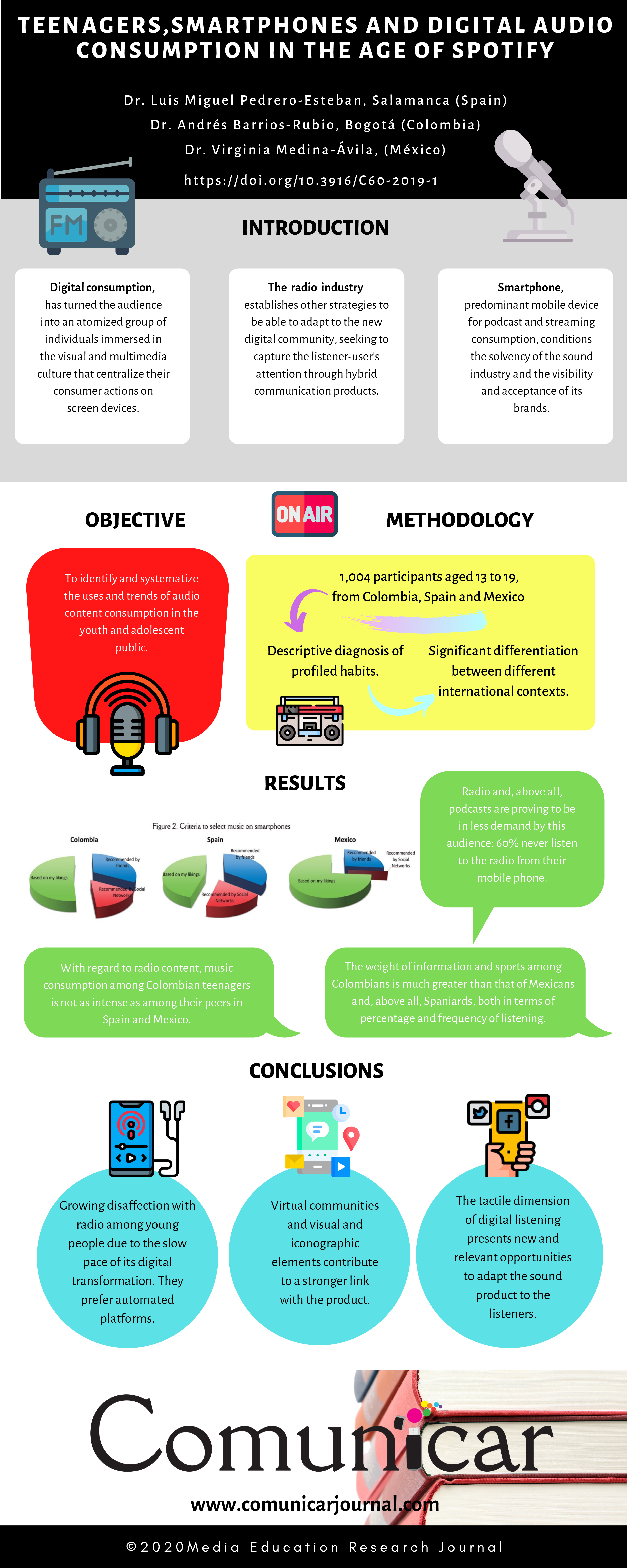
The consolidation of smartphones as dominant devices for access to digital information and entertainment has redefined the processes of production and commercialization of cultural communication industries. The nature of these screens, which prioritize the visual content over the sound, decisively influences distribution strategies in the audio market: radio operators, streaming music platforms and podcast creators need to adapt their value chains to the habits derived from this mediation, especially in the younger audience. This research identifies the practices of mobile use as an audio receiver among adolescents in Colombia, Spain and Mexico –the most representative countries of Spanish-speaking digital sound consumption– based on a descriptive study on a thousand subjects from 13 to 19 years of age. The results confirm the overwhelming dominance in this music menu in the face of low penetration of radio and podcast word content. The selection is based on personal criteria, with little margin for the prescription of family or friends. There is evidence of the roots of individual listening, linked to the brand and the visibility of audio providers, who are obliged to develop diffusion logics based not only on thematic or genre preferences, but also on the user experience.
References
Link DOI | Link Google Scholar
Link DOI | Link Google Scholar
Canal Éxito (2018). El audiolibro se consolida como nuevo formato de lectura. https://bit.ly/2E7tXZ8
Canavilhas, J. (2009). Contenidos informativos para móviles: estudio de aplicaciones para iPhone. Textual & Visual media, 2, 61-80. https://bit.ly/2nPsYVI
Castells, M. (2006). La sociedad Red. Barcelona: Alianza. https://doi.org/10.4272/84-9745-045-0.ch1
Link DOI | Link Google Scholar
Cebrián-Herreros, M. (2009). La radio en la convergencia multimedia. Barcelona: Gedisa.
Díaz-Nosty, B. (2017). Coexistencia generacional de diferentes pra?cticas de comunicacio?n. In B. Díaz-Nosty, (Coord.), Diez an?os que cambiaron los medios: 2007-2017 (pp. 7-26). Barcelona: Ariel.
Link DOI | Link Google Scholar
Link DOI | Link Google Scholar
Galloway, S. (2017). El ADN secreto de Amazon, Apple, Facebook y Google. Madrid: Penguin Random House.
García-Avilés, J.A., Martínez-Costa, M.P., & Sádaba, C. (2016). Luces y sombras sobre la innovación en los medios españoles. In C. Sádaba, J.A. García-Avilés, & M. P. Martínez-Costa (Coords.), Innovación y desarrollo de los cibermedios en España (pp. 265-270). Pamplona: Eunsa. http://bit.ly/2YIkNMg
Link DOI | Link Google Scholar
Google (2018). Consumer barometer study 2018. The year of the mobile majority. https://bit.ly/2tBEk2w
Link DOI | Link Google Scholar
Link DOI | Link Google Scholar
Link DOI | Link Google Scholar
IAB & PwC (Eds.) (2018). Full year 2017 podcast ad revenue study: An analysis of the us podcast advertising industry. Interactive Advertising Bureau and PricewaterhouseCoopers. https://bit.ly/2HNC0Kq
IBOPE (2017). Consumo de medios en Colombia. https://bit.ly/2MwnMnA
IFPI (Ed.) (2018). Global Music Report 2018. Annual State of the Industry. International Federation of the Phonographic Industry. https://bit.ly/2qhzuWl
INEGI (Eds.) (2017). Encuesta nacional sobre disponibilidad y uso de tecnologías de la información en los hogares, 2017 – ENDUTIH. Madrid: Instituto Nacional de Estadística y Geografía. https://bit.ly/2PVM2gv
Jarvis, J. (2015). El fin de los medios de comunicación de masas. ¿Cómo serán las noticias del futuro? Barcelona: Gestión 2000.
López-Vidales, N., Gómez-Rubio, L., & Redondo-García, M. (2014). La radio de las nuevas generaciones de jóvenes españoles: hacia un consumo online de música y entretenimiento. Zer, 19(37), 45-64. https://bit.ly/2E3zjV2
Martí, J.M., Monclús, B., Gutiérrez, M., & Ribes, X. (2015). La radio, modelo de negocio en transición: estrategias de oferta y de comercialización en el contexto digital. Quaderns del CAC, (41), 13-22. https://bit.ly/2OMEf4B
Martínez-Costa, M.P. (2015). Radio y nuevas narrativas: de la crossradio a la transradio. In M. Oliveira, & F.F. Ribeiro, (Eds.), Radio, sound and Internet Proceedings of Net Station International Conference (pp. 168-187). Brasil: Centro de Estudos de Comunicação e Sociedade (CECS), Universidade do Minho. https://bit.ly/2tBCkaE
Link DOI | Link Google Scholar
Neira, E. (2015). La otra pantalla. Redes sociales, móviles y la nueva televisión. Barcelona: UOC.
Newzoo (2018). Global Mobile Market Report, 2018. https://bit.ly/2ugzNBH
Nielsen (2012). Music 360º Report. https://bit.ly/2XvcqTE
OpenSignal (Ed.) (2018). State of mobile networks: USA. https://bit.ly/2NptCoU
Link DOI | Link Google Scholar
Link DOI | Link Google Scholar
Link DOI | Link Google Scholar
Link DOI | Link Google Scholar
Link DOI | Link Google Scholar
Perona-Páez, J.J., Barbeito-Veloso, M. & Fajula-Payet, A. (2014). Young people in the digital sonosphere: Media digital, media devices and audio consumption habits. Communication & Society, 27(1), 205-224. https://bit.ly/2L3R0FI
Link DOI | Link Google Scholar
Ramos-del-Cano, F. (2014). Redes sociales y participación radiofónica: análisis de caso de Twitter y Facebook en la Cadena SER. Ámbitos, 25, 66-76. https://bit.ly/2BOV0rI
Ribes, X., Monclús, B. & Gutiérrez, M. (2015). Del oyente al radioprosumer: Gestión de la participación de la audiencia en la radio del siglo XXI. Trípodos, 36, 55-74. https://bit.ly/2L6J3zp
Ribes, X., Monclús, B., Gutiérrez-García, M., & Martí, J.M. (2017). Aplicaciones móviles radiofónicas: adaptando las especificidades de los dispositivos avanzados a la distribución de los contenidos sonoros. Revista de la Asociación Española de Investigación de la Comunicación, 4(7), 29-39. https://bit.ly/2MnWnVM
Salaverría, R. (2010). Estructura de la convergencia. In X. López, & X. Pereira (Eds.). Convergencia digital. Reconfiguración de los medios de comunicación en España (pp. 27-40). Santiago de Compostela: Servicio Editorial de la Universidad de Santiago de Compostela. http://bit.ly/2UvAgA4
Salaverría, R., & García, J. A. (2008). La convergencia tecnológica en los medios de comunicación: Retos para el periodismo. Trípodos, (23), 31-47. https://bit.ly/2nQFCDH
Scolari, C.A. (2015). Ecología de los medios: Entornos, evoluciones e interpretaciones. Madrid: Gedisa.
Siemens, G. (2008). Learning and knowing in networks: Changing roles for educators and designers. ITFORUM for Discussion. https://bit.ly/2VhLEvX
Link DOI | Link Google Scholar
Link DOI | Link Google Scholar
Storytel (2018). Historias originales seriadas. Apuesta estratégica de las plataformas de la economía de la suscripción. https://bit.ly/2T3lQqY
We Are Social (Ed.) (2018). Digital In 2017: Global overview. https://bit.ly/2rvcmGk
Fundref
This work has no financial support
Crossmark

Technical information
Received: 26-12-2018
Revised: 01-02-2019
Accepted: 20-02-2019
OnlineFirst: 15-05-2019
Publication date: 01-07-2019
Article revision time: 37 days | Average time revision issue 60: 48 days
Article acceptance time: 56 days | Average time of acceptance issue 60: 64 days
Preprint editing time: 142 days | Average editing time preprint issue 60: 150 days
Article editing time: 187 days | Average editing time issue 60: 195 days
Metrics
Metrics of this article
Views: 24103
Abstract readings: 20564
PDF downloads: 3539
Full metrics of Comunicar 60
Views: 453422
Abstract readings: 395822
PDF downloads: 57600
Cited by

Cites in Web of Science
Manuel De Sancha-Navarro, Jesus; Palma Martos, Luis; Dolores Oliver-Alfonso, Maria;. EXPLANATORY FACTORS OF UNIVERSITY STUDENT PARTICIPATION IN FLAMENCO ECONOMICS & SOCIOLOGY , 2019.
https://doi.org/10.14254/2071-789X.2019/12-4/8
Consuclo Lemus-Pool, Maria; Barcenas-Curtis, Cesar; Alberto Gomez-Issasi, Jose; . Youth and digital technologies. Diagnosis of the use and appropriation of digital platforms in the conurbation area of southern Tamaulipas CIENCIAUAT, 2020.
https://doi.org/10.29059/cienciauat.v14i2.1359
Luis Rojas-Torrijos, Jose; Javier Caro-Gonzalez, Francisco; Antonio Gonzalez-Alba, Jose;. The Emergence of Native Podcasts in Journalism: Editorial Strategies and Business Opportunities in Latin America MEDIA AND COMMUNICATION , 2020.
https://doi.org/10.17645/mac.v8i2.2699
Perez-Escoda, Ana; Jimenez-Narros, Carlos; Perlado-Lamo-de-Espinosa, Marta;. Social Networks' Engagement During the COVID-19 Pandemic in Spain: Health Media vs. Healthcare Professionals INTERNATIONAL JOURNAL OF ENVIRONMENTAL RESEARCH AND PUBLIC HEALTH , 2020.
https://doi.org/10.3390/ijerph17145261
Rodriguez Luque, Cristina; Alonso Fernandez, Jose Antonio; Maria Legorburu, Jose;. From audio library to podcast: Analysis of the Spanish talk radio's main programs in open repositories DOCUMENTACION DE LAS CIENCIAS DE LA INFORMACION , 2020.
https://doi.org/10.5209/dcin.67234
Moreno Cazalla, Lourdes; Pedrero Esteban, Luis Miguel;. Digital transformation of musical radio: The case of Maxima/LOS40 Dance COMUNICACIO-REVISTA DE RECERCA I D ANALISI , 2020.
https://doi.org/10.2436/20.3008.01.191
Medina Avila, Virginia; Salcedo Mena, Jose Arturo; . ADOLESCENTS, SMARTPHONES AND DIGITAL AUDIO CONSUMPTION IN MEXICO REVISTA INCLUSIONES, 2020.
Barrios-Rubio, Andres; Pedrero-Esteban, Luis Miguel;. The Transformation of the Colombian Media Industry in the Smartphone Era JOURNAL OF CREATIVE COMMUNICATIONS , 2021.
https://doi.org/10.1177/0973258620981347
Turner, JS and Tollison, AC. The Evolving Communicative Value of Popular Music: Music Is Interpersonal Communication in the Age of Digital Media JOURNAL OF BROADCASTING & ELECTRONIC MEDIA, 2000.
https://doi.org/10.1080/08838151.2021.1957893
Vizcaino-Verdu, A; Aguaded, I and Contreras-Pulido, P. Understanding Transmedia Music on YouTube through Disney Storytelling SUSTAINABILITY, 2000.
https://doi.org/10.3390/su13073667
Barrios-Rubio, A. Radio, music and podcast in the consumption agenda of Colombian adolescents and youth in the digital sonosphere COMMUNICATION & SOCIETY-SPAIN, 2021.
https://doi.org/10.15581/003.34.3.31-46
Barrios-Rubio, A. The Colombian Media Industry on the Digital Social Consumption Agenda in Times of COVID-19 INFORMATION, 2022.
https://doi.org/10.3390/info13010011
Fraile, EB; Jimenez, AME; (...); Payet, AF. Sonic identity and audio branding elements in Spanish radio advertising ANALISI-QUADERNS DE COMUNICACIO I CULTURA, 2021.

Cites in Scopus
Pérez-Escoda, A., Jiménez-Narros, C., Perlado-Lamo-de-espinosa, M., Pedrero-Esteban, L.M. . Social networks’ engagement during the COVID-19 pandemic in Spain: Health media vs. healthcare professionals), International Journal of Environmental Research and Public Health, .
https://doi.org/10.3390/ijerph17145261
de Sancha-Navarro, J.M., Martos, L.P., Oliver-Alfonso, M.D. . Explanatory factors of university student participation in flamenco), Economics and Sociology, .
https://doi.org/10.14254/2071-789X.2019/12-4/8
Rojas-Torrijos, J.L., Caro-González, F.J., González-Alba, J.A. . The emergence of native podcasts in journalism: Editorial strategies and business opportunities in Latin America), Media and Communication, .
https://doi.org/10.17645/mac.v8i2.2699
Barrios-Rubio, A., Pedrero-Esteban, L.M. . The Transformation of the Colombian Media Industry in the Smartphone Era), Journal of Creative Communications, .
https://doi.org/10.1177/0973258620981347
Vizcaíno-Verdú, A., Aguaded, I., Contreras-Pulido, P. . Understanding transmedia music on youtube through disney storytelling), Sustainability (Switzerland), .
https://doi.org/10.3390/su13073667
Gutiérrez-Garciá, M., Barrios-Rubio, A. . Youth sound consumption practices, between big platforms and the radio ecosystem: The case of Colombia-Spain | [Prácticas juveniles de consumo sonoro, entre grandes plataformas y el ecosistema radiofónico: Caso Colombia-Espanã]), Comunicacion y Sociedad (Mexico), .
https://doi.org/10.32870/cys.v2021.7820
Legorburu, J.M., Edo, C., González, A.G. . Radio feature and podcasting, the awakening of a sleeping genre in Spain. The Podium Podcast study case | [Reportaje sonoro y podcasting, el despertar de un género durmiente en España. El caso de Podium Podcast1]), Estudios Sobre el Mensaje Periodistico, .
https://doi.org/10.5209/ESMP.71204
Barrios-Rubio, A. . Radio, music and podcast in the consumption agenda of colombian adolescents and youth in the digital sonosphere), Communication and Society, .
https://doi.org/10.15581/003.34.3.31-46
Turner, J.S., Tollison, A.C. . The Evolving Communicative Value of Popular Music: Music Is Interpersonal Communication in the Age of Digital Media), Journal of Broadcasting and Electronic Media, .
https://doi.org/10.1080/08838151.2021.1957893
De-Miguel-Zamora, M., Borau-Boira, E., Abellán-Hernández, M.. The case of BBVA Aprendemos juntos as a brand story model), Revista Mediterranea de Comunicacion, .
https://doi.org/10.14198/MEDCOM.20765
Barrios-Rubio, A.. The Colombian Media Industry on the Digital Social Consumption Agenda in Times of COVID-19), Information, .
https://doi.org/10.3390/info13010011
Lema, R.C., Palomino-Flores, P.. Use of narrative in Podcast elements: Moloko and Sin Paltas), Proceedings of the 2021 IEEE 1st International Conference on Advanced Learning Technologies on Education and Research, ICALTER 2021, .
https://doi.org/10.1109/ICALTER54105.2021.9675082
Fraile, E.B., Jiménez, A.M.E., Veloso, M.L.B., Payet, A.F.. Sonic identity and audio branding elements in Spanish radio advertising), Analisi, .
https://doi.org/10.5565/REV/ANALISI.3330
Cabrera-Gala, R. . Research in the field of communication in Mexico: Topics, findings, and opportunity areas, the first step to develop research plans), Cases on Developing Effective Research Plans for Communications and Information Science, .

Cites in Google Scholar
Lemus-Pool, M. C., Bárcenas-Curtis, C., & Gómez-Issasi, J. A. (2020). Jóvenes y tecnologías digitales. Diagnóstico del uso y apropiación de plataformas digitales en la zona conurbada del sur de Tamaulipas. CienciaUAT, 14(2), 87-103.
http://www.scielo.org.mx/scielo.php?script=sci_arttext&pid=S2007-78582020000100087
ABARZUZA, I. S. Espai web patrocinat per.
http://sonograma.org/2020/01/2020-el-informe-de-la-minoria-y-la-curacion-de-la-musica/
OIiver-Alfonso, M. D. (2019). Explanatory factors of university student participation in flamenco. Sociology, 12(4), 130-148.
https://core.ac.uk/download/pdf/299807958.pdf
Rojas-Torrijos, J. L., Caro-González, F. J., & González-Alba, J. A. (2020). The emergence of native podcasts in journalism: Editorial strategies and business opportunities in Latin America. Media and Communication, 8(2), 159-170.
https://www.cogitatiopress.com/mediaandcommunication/article/view/2699
Pool, M. C. L., Curtis, C. B., & Isassi, J. A. G. (2020). Jóvenes y tecnologías digitales. Diagnóstico del uso y apropiación de plataformas digitales en la zona conurbada del sur de Tamaulipas. CienciaUAT, 14(2), 87-103.
https://dialnet.unirioja.es/servlet/articulo?codigo=7364836
Cazalla, L. M., & Esteban, L. M. P. La transformación digital de la radio musical: el caso de Máxima/LOS40 Dance.
https://www.academia.edu/download/63416591/TransformacionLos40Dance20200525-58376-1jcmcr6.pdf
Moreno Cazalla, L., & Pedrero Esteban, L. M. La transformació digital de la ràdio musical: el cas de Máxima/LOS40 Dance. Comunicació. Revista de recerca i d'anàlisi [abans Treballs de Comunicació], 37(1), 75-94.
http://revistes.iec.cat/index.php/TC/article/viewArticle/148120
Pedrero-Esteban, L. M., Barrios-Rubio, A., & Medina-Ávila, V. (2019). Teenagers, smartphones and digital audio consumption in the age of Spotify. Comunicar. Media Education Research Journal, 27(2).
Martinenco, R. M., Martín, R. B., & Romano, L. G. (2021). Ecologías de aprendizaje en educación secundaria: TIC y aprendizaje informal. Revista Tecnología, Ciencia y Educación, (18), 77-97.
https://dialnet.unirioja.es/servlet/articulo?codigo=7758798
Rafael, V. V. D. SISTEMA CONTEXTUALIZADO DE EVALUACIÓN DOCENTE, UNA EXPERIENCIA FORMATIVA EN EL NIVEL MEDIO SUPERIOR.
DiBacco, K. (2020). Differences in Reading Comprehension Levels for Students between Traditional Reading and Audio Recording Methods (Doctoral dissertation, Houston Baptist University).
Barrios-Rubio, A., & Gutiérrez-García, M. (2021). Prácticas juveniles de consumo sonoro, entre grandes plataformas y el ecosistema radiofónico: caso Colombia-España. Comunicación y Sociedad, 1-24.
http://www.comunicacionysociedad.cucsh.udg.mx/index.php/comsoc/article/view/e7820
Luque, C. R., Fernández, J. A. A., & Legorburu, J. M. (2020). De la fonoteca al pódcast: Análisis de los magacines estrella de la radio generalista española en los repositorios abiertos. Documentacion de las Ciencias de la Informacion, (43), 15-22.
Rojas-Torrijos, J. L., Caro-González, F. J., & González Alba, J. A. (2020). The emergence of native podcasts in journalism: Editorial strategies and business opportunities in Latin America.
https://rodin.uca.es/handle/10498/22966
García-Jiménez, A., López, M. C. L. D. A., & Montes-Vozmediano, M. Características y percepciones sobre el uso de las plataformas de redes sociales y dispositivos tecnológicos por parte de los adolescentes. ZER: Revista de Estudios de Comunicación= Komunikazio Ikasketen Aldizkaria, 25(48).
http://myjms.moe.gov.my/index.php/ajrbm/article/view/10215
Pérez-Escoda, A., Jiménez-Narros, C., Perlado-Lamo-de-Espinosa, M., & Pedrero-Esteban, L. M. (2020). Social Networks’ Engagement During the COVID-19 Pandemic in Spain: Health Media vs. Healthcare Professionals. International journal of environmental research and public health, 17(14), 5261.
https://www.mdpi.com/1660-4601/17/14/5261
Triumami, A. G., & Nuraeni, S. (2020). Determinant Factors Affecting Podcast Users’ Acceptance to Listen to Podcast. Asian Journal of Research in Business and Management, 2(2), 144-153.
http://myjms.mohe.gov.my/index.php/ajrbm/article/view/10215
Otón, L. M., Lozano, E. C., & Esteban, L. M. P. (2020). La radio como agente de cohesión universitaria en tiempos de pandemia. Radiofonias–Revista de Estudos em Mídia Sonora, 11(3), 22-22.
https://periodicos.ufop.br:8082/pp/index.php/radiofonias/article/view/4350
Llano, F. A. (2021). The podcast as a socializing device and the inclusion of digital narratives at school.
https://osf.io/preprints/wphaf/
Pool, M. C. L., & González, R. L. (2021). Tipologías de navegación en plataformas digitales: el caso de los estudiantes del sur de Tamaulipas. PAAKAT: Revista de Tecnología y Sociedad, (20).
http://148.202.167.189/paakat/index.php/paakat/article/view/579
Gómez, A. A., Bolinches, R. T., & Esteban, L. M. (2019). La indexación del podcast en agregadores de audio y plataformas de streaming musical: estrategias y criterios de categorización. Textual & Visual Media, (12).
https://textualvisualmedia.com/index.php/txtvmedia/article/view/240
Lemus-Pool, M. C., Bárcenas-Curtis, C., & Gómez-Issasi, J. A. (2020). Youth and digital technologies. Diagnosis of the use and appropriation of digital platforms in the conurbation area of southern Tamaulipas. CienciaUAT, 14(2), 87-103.
http://www.scielo.org.mx/scielo.php?pid=S2007-78582020000100087&script=sci_abstract&tlng=en
García Jiménez, A., López de Ayala López, M. C., & Montes Vozmediano, M. (2020). Características y percepciones sobre el uso de las plataformas de redes sociales y dispositivos tecnológicos por parte de los adolescentes.
https://addi.ehu.es/handle/10810/47228
Pedrero-Esteban, L. M., Barrios-Rubio, A., & Medina-Ávila, V. (2019). Adolescentes, smartphones y consumo de audio digital en la era de Spotify.
http://expeditiorepositorio.utadeo.edu.co/handle/20.500.12010/8571
Barrios-Rubio, A., & Pedrero-Esteban, L. M. (2021). The Transformation of the Colombian Media Industry in the Smartphone Era. Journal of Creative Communications, 16(1), 45-60.
Guevara, M. I., & Llano, F. A. El podcast como dispositivo socializador y la inclusión de las narrativas digitales en la escuela The podcast as a socializing device and the inclusion of digital narratives at school O podcast como dispositivo de socialização e à inclusão de narrativas digitais na escola.
Jiménez Salazar, S. E. (2019). Representaciones y prácticas sociales del consumo de radio web, podcast de audio y radio tradicional en jóvenes universitarios de Bogotá (Doctoral dissertation, Bogotá, DC: Fundación Universitaria Konrad Lorenz, 2019).
https://repositorio.konradlorenz.edu.co/handle/001/2383
Rivera Magos, S. Consumos streaming juveniles de música. El caso de los jóvenes consumidores de la Zona Metropolitana de Querétaro Youth streaming music consumption. The case of young consumers in the Metropolitan Area of Querétaro.
https://www.methaodos.org/revista-methaodos/index.php/methaodos/article/download/396/591?inline=1
Magos, S. R. (2020). Consumos streaming juveniles de música. El caso de los jóvenes consumidores de la Zona Metropolitana de Querétaro. methaodos. revista de ciencias sociales, 8(2), 227-241.
https://revista.methaodos.org/index.php/methaodos/article/view/396
DAROS, W. EDUCACIÓN Y ADICCIÓN en el clima de la posmodernidad.
Cea, N., & Vicente, A. M. D. (2020). El uso del podcasting en el aprendizaje: evaluación de usos y experiencias en la literatura académica.
https://accedacris.ulpgc.es/handle/10553/76442
Guerrero, M. V. HÁBITOS DE CONSUMO RADIOFÓNICO EN ESTUDIANTES UNIVERSITARIOS ANTES DE LA PANDEMIA. Comunicación y salud en la era posdigital, 63.
Lemus Pool, M. C., & López González, R. (2021). Tipologías de navegación en plataformas digitales: el caso de los estudiantes del sur de Tamaulipas. PAAKAT: revista de tecnología y sociedad, 11(20).
http://www.scielo.org.mx/scielo.php?pid=S2007-36072021000100004&script=sci_arttext
Download

Alternative metrics
How to cite
Pedrero-Esteban, L., Barrios-Rubio, A., & Medina-Ávila, V. (2019). Teenagers, smartphones and digital audio consumption in the age of Spotify. [Adolescentes, smartphones y consumo de audio digital en la era de Spotify]. Comunicar, 60, 103-112. https://doi.org/10.3916/C60-2019-10
Share








Oxbridge Publishing House
4 White House Way
B91 1SE Sollihul United Kingdom
Administration 
Editorial office